
Enhancing the Role of the Directorate for Carbon Economic Value Governance of the Ministry of Environment in accelerating Indonesia's Carbon Trading Development
Implementation of Carbon Economic Value (NEK) and the Development of Indonesia’s Carbon Market Ecosystem

Representing the Hanns Seidel Foundation, Nila Puspita joined Dr. Wahyu Marjaka, Director of Carbon Economic Value Governance, and Esprana Hotnatiur Sianipar, SHUt., ME, Expert to the Minister of Environment, in addressing the workshop.
HSF
Key Topics Discussed
Primary Market
Indonesia’s primary carbon market serves as the foundational platform for issuing Emission Reduction Certificates (SPEI). Its core mechanism includes validation of mitigation projects by independent institutions, establishment of emission baselines, and verification of greenhouse gas (GHG) reductions by the Directorate of GHG Inventory and Monitoring, Ministry of Environment. Projects are registered through the MPV (Monitoring Reporting and Verification) Registry prior to certification by the Directorate of Carbon Economic Value Governance (TKPNEK), with strict emission quota allocations for priority sectors. This market underpins Indonesia’s NDC achievement, with each certificate representing a verified, on-the-ground emission reduction.
Secondary Market
The secondary market facilitates the trading of issued carbon certificates, with IDX Carbon (Indonesia Carbon Exchange) serving as the primary exchange. Trading mechanisms include daily auctions and spot transactions, with prices driven by supply and demand dynamics. All transactions are recorded and settled through the National Registry System (SRN) to ensure data integrity. The Financial Services Authority (OJK) oversees market operations, ensuring transparency, preventing manipulation, and safeguarding investor interests. This market enhances liquidity for certificate holders and serves as a benchmark for carbon pricing in Indonesia.
Oversight of the Carbon Market
Carbon market oversight is anchored on three pillars: monitoring, enforcement, and auditing. The SRN enables real-time tracking of transactions and data reconciliation between project registries and the exchange. TKPNEK has developed a comprehensive audit protocol implemented by independent institutions, supported by a whistleblowing mechanism for reporting violations. OJK supervises trading activities, while the Audit Board of Indonesia (BPK) audits state revenue derived from carbon-related non-tax income (PNBP). Together, these mechanisms foster a transparent and accountable ecosystem aligned with national climate goals.
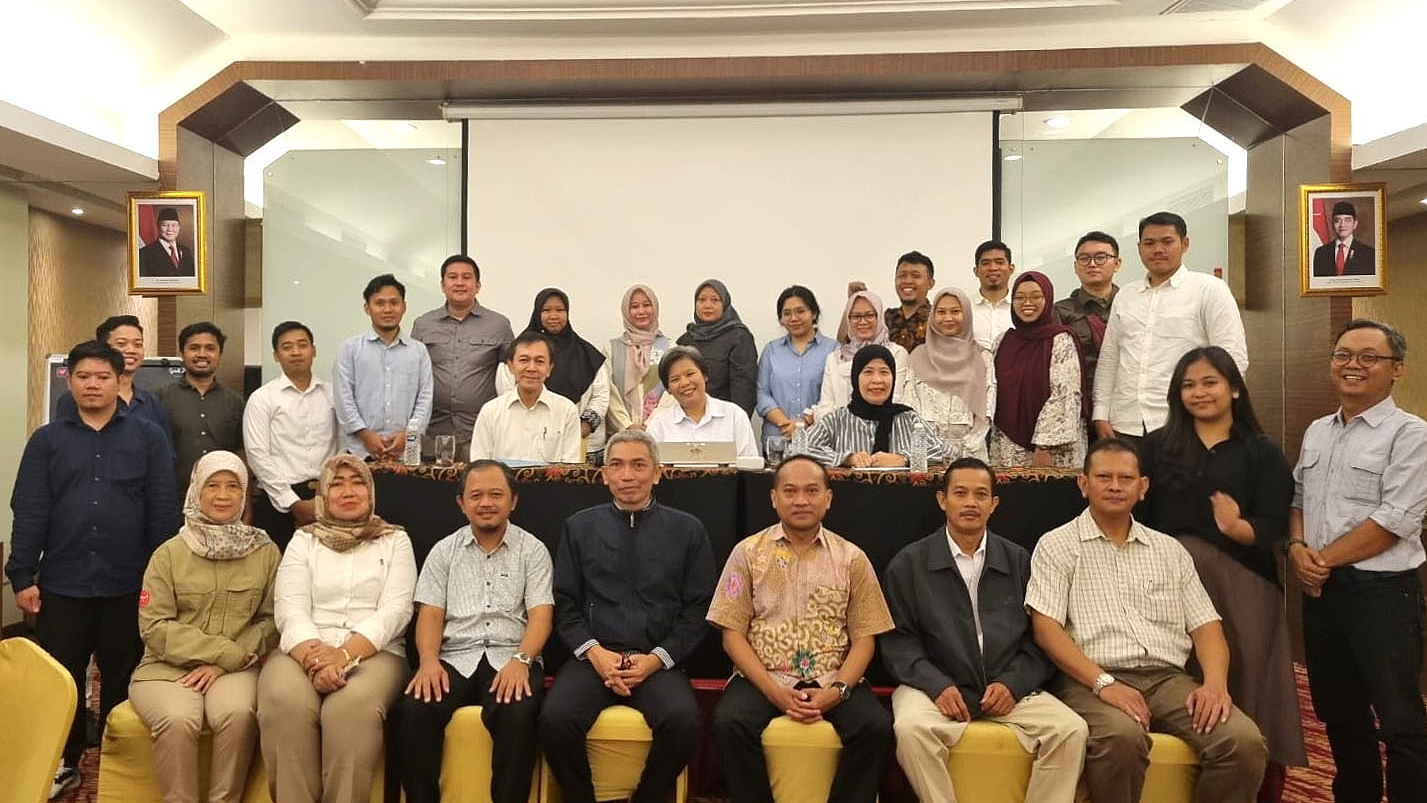
Participants of the workshop
HSF
Recognizing the pivotal role of TKPNEK in ensuring the effective operation of carbon trading—particularly within the primary market—the workshop outlined the following expectations:
1. Deepen understanding of the Primary Market mechanism within SRN and the SPEI (Indonesia Certificate of Greenhouse Gas Emission Reduction) issuance process by PPI.
2. Strengthen technical knowledge of SPEI processes (buffering, authorization, cancellation) and their link to NDC achievement.
3. Comprehend carbon trading schemes under PTBAE-PU (Technical Approval of Emission Cap – Business Actors) and SPE-GRK (Greenhouse Gas Emission Reduction Certificate) for the energy, waste, and forestry sectors.
4. Identify potential violations, system errors, and human errors within SRN operations.
5. Enhance capacity for managing the SPEI certification process.
6. Understand the implementation of Article 6 of the Paris Agreement
The presence of high-level experts such as Dr. Wahyu Marjaka (Director of TKPNEK), Esprana Hotnatiur Sianipar, SHUt., ME (Advisor to the Minister of Environment), Yohannes Kristianto (IDX Carbon/Indonesia Carbon Exchange), and Dr. Ir. Joko Prihanto, MM (Carbon Trading Consultant) enriched the discussions and helped shape strategic recommendations.
The workshop made a meaningful contribution to accelerating the development of a robust carbon trading ecosystem in Indonesia. Its outcomes lay a strategic foundation for building a transparent, liquid, and accountable system—advancing inclusive and equitable green economic growth for all stakeholders.