
HSF Vietnam at United Nations Summit of the Future and New York Climate Week
High-level site-events and meetings at the UN Summit of the Future 2024 & New York Climate Week

High-level side-event hosted by UNDP Global team during the Summit of the Future.
HSF
During the UN Summit of the Future and New York Climate Week 2024 in September 2024, HSF Vietnam co-organized two key events with international partners from Chatham House, the World Business Council for Sustainable Development and the Wyss Academy for Nature. These events featured the launch of the Policy Paper on Circular Economy Futures 2050, which was shaped by previous circular economy roundtables in Bangkok, Nairobi, Lima, Delhi and Geneva. These events have developed key recommendations to advance the global circular economy and promote sustainable development.
Outcomes of the events and dialogues co-hosted by HSF in New York can be summarised as follows:
a. Reflections on the Summit of the Future 2024 and the Role of Circularity for an Updated Post-2030 SDG Framework
With growing environmental challenges like resource depletion, waste management, and unsustainable production, integrating circular economy principles into the SDG framework can address these issues. Circularity should be seen not just as an environmental tool but as a solution for multiple SDGs. It directly supports SDG 12 (Responsible Consumption and Production), SDG 13 (Climate Action), and SDGs 14 and 15 (Life Below Water and Life on Land) by promoting sustainable resource use, reducing waste, and encouraging eco-friendly production. Circular economy strategies also contribute to the Pact for the Future, guiding a more inclusive and sustainable world. By reducing waste and promoting recycling, circular models help reduce greenhouse gas emissions and support climate change mitigation. Transitioning from linear to circular economies is essential for effective climate action and enhancing ecosystem resilience.

High-level roundtable on Global Circular Economy Roadmap Initiative: Circular Economy Futures 2050
HSF
b. Key Aspects of Institutional Arrangements and International Coordination for a Globally Coordinated Approach to an Inclusive Circular Economy
During discussions on institutional frameworks from a key event co-hosted by HSF: “Making the Circular Economy Work for Global Development: How the UN Summit of the Future Can Deliver”, 4 essential keynotes on how CE can drive SDGs implementation and support the transition to a more sustainable future:
- The circular economy is crucial for revitalizing the SDGs, offering solutions that impact all 17 goals and propel global progress.
- Scaling the circular economy requires global collaboration. A just transition needs enhanced coordination in finance, trade, policy, and common standards.
- No country can make this shift alone—North-South partnerships are key to achieving shared success.
- By 2050, the circular economy offers a transformative roadmap for global development. The targets may be ambitious, but they are within reach.
c. Joint Strategies for Advancing the Implementation of a Global Inclusive Circular Economy
At the “Circular Economy Futures 2050: Shaping the Action Agenda,” the need for financial instruments to support the transition to a circular economy in developing countries was emphasized. A fund, similar to the Green Climate Fund, was proposed to assist with infrastructure development, technology adoption, and capacity building. This fund could also support pilot projects to demonstrate the viability of circular economy models. High-level speakers, including UN Assistant Secretary-General Ligia Noronha and IRP Co-Chair Dr. Izabella Teixeira, noted that the current situation is more accurately described as "greenwishing" rather than "greenwashing."
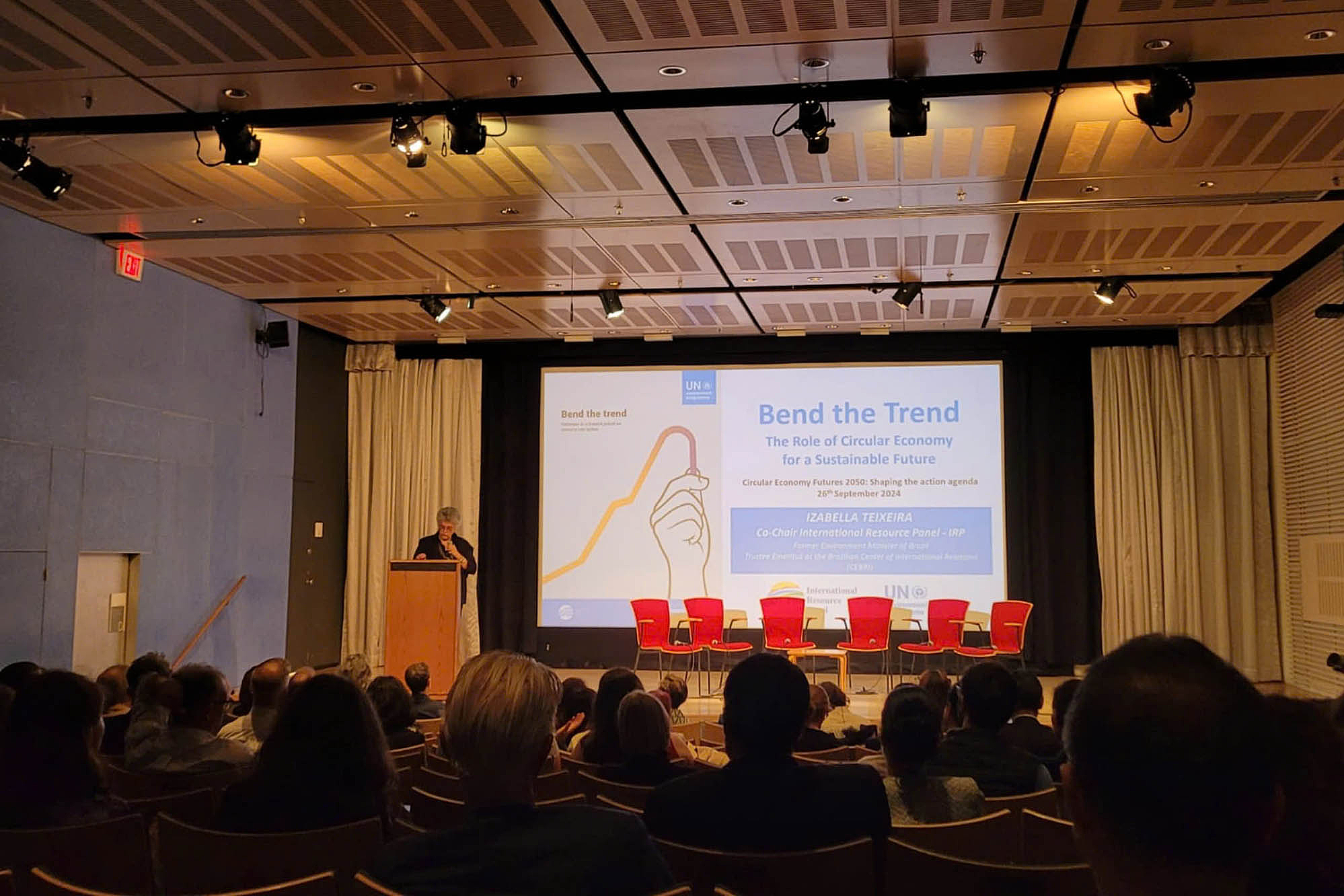
Circular Economy Futures 2050: Shaping the Action Agenda, co-hosted by HSF, Chatham House, WBCSD and the Wyss Academy
HSF
The event followed up on previous discussions about circularity in the context of the UN Summit of the Future and presented key findings from the "Circular Economy Futures 2050" policy paper, aimed at creating a unified vision and actionable pathways for international cooperation in policy, trade, and finance. The impact analysis of the Global Circularity Protocol’s effects on climate, nature, and social equity was also shared.
d. The Future of Circularity: Identifying Quick and Pragmatic Pathways for Implementing Circular Strategies and Business Models
One of the key focus areas was the need to target specific sectors that have a high environmental impact, such as agriculture, construction, and manufacturing. By focusing on these sectors, the transition to a circular economy can yield immediate benefits in terms of reducing resource consumption, minimizing waste, and lowering greenhouse gas emissions. For instance, in agriculture, circular practices such as composting, sustainable water management, and crop rotation can improve soil health and increase productivity while reducing environmental harm. Similarly, in construction, using recycled materials and designing buildings for disassembly can greatly reduce resource extraction and waste.
HSF’s Global Project on the Mitigation and Adaptation of Climate Change (GMACC) is proud to have co-hosted and participated in such high-profile events at the UN Summit of the Future and New York Climate Week. This reflects our ongoing commitment to advancing the circular economy on different levels and in diverse contexts as a key component of our global and interconnected approach.