
Implementation of the National Action Plan on Circular Economy
From policy to practice: Strengthening circular economy planning and innovation in the Central region
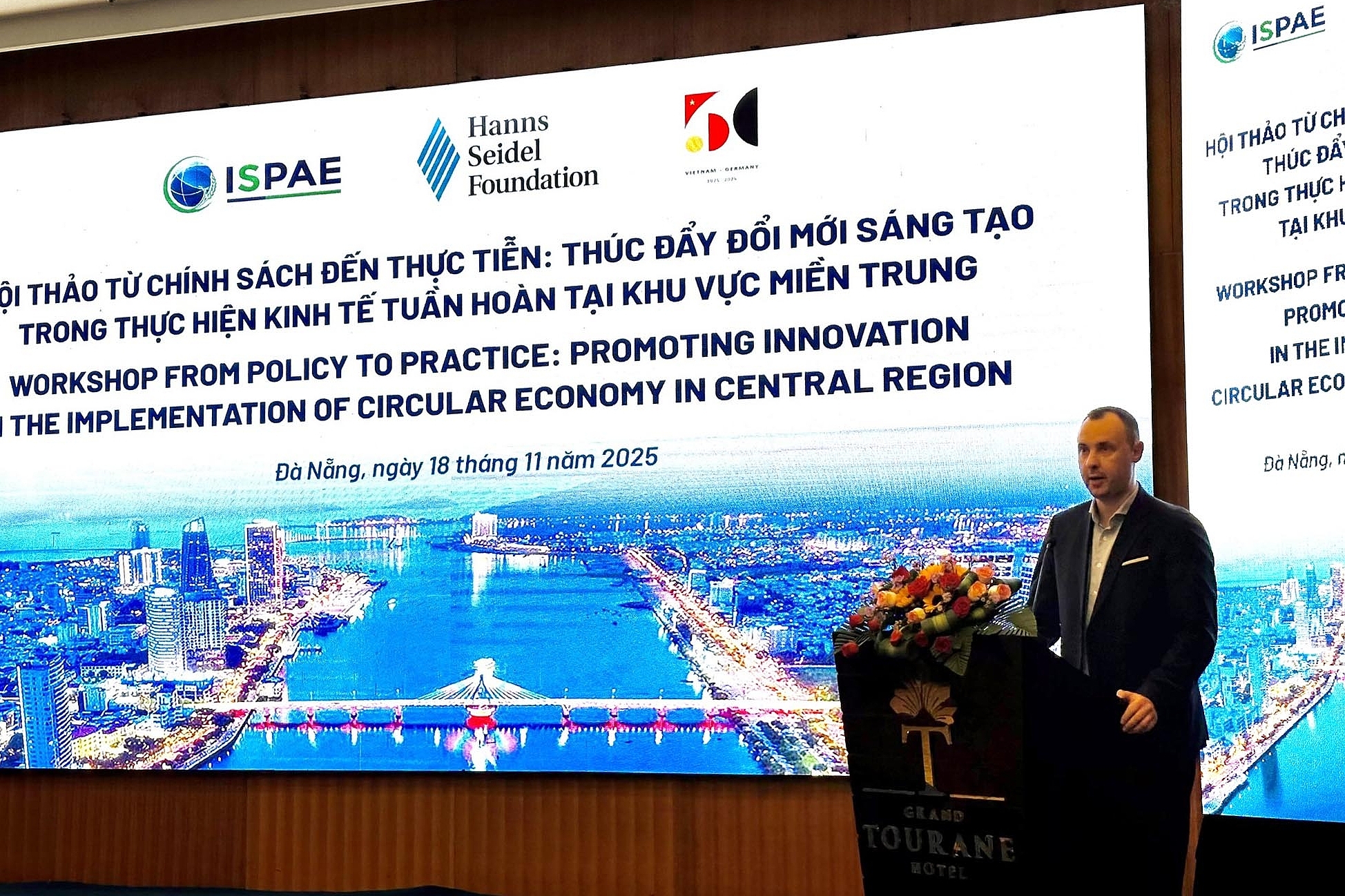
Mr Michael Siegner, Resident Representative of HSF Vietnam, delivered the opening speech
HSF
The workshop “From Policy to Practice: Strengthening Circular Economy Planning and Innovation in the Central Region” was held on 18 November 2025 in Da Nang, co-organized by ISPAE and the Hanns Seidel Foundation (HSF). The event brought together provincial authorities, research institutes, universities, development partners, and enterprises to explore how innovative solutions can accelerate circular economy (CE) implementation and support provinces in developing their CE action plans. Opening remarks from ISPAE underscored the strategic role of CE in national and provincial planning, while HSF highlighted the importance of international cooperation and knowledge exchange in driving CE innovation. Early technical sessions provided updates on national CE policies, local waste management challenges, and emerging opportunities for applying CE principles in the Central region. Presentations from Da Nang’s environmental authority and the Hue Institute for Development Studies showcased how local governments are beginning to adopt innovative models—from data-led waste management to integrated urban planning and heritage-based resource recovery.
A core highlight was the strong focus on enterprise-driven innovation. The Center for Creativity and Sustainability Study introduced circular business models and technologies being piloted in the region, demonstrating how companies are experimenting with resource recovery, product redesign, eco-industrial linkages, and digital platforms to support circular transitions. Private-sector experts discussed scalable solutions such as smart waste-sorting systems, circular textile production, and low-carbon industrial symbiosis—showing that CE offers both environmental benefits and real economic opportunities for local businesses.

Best practices on CE application in Hue city were presented at the workshop
HSF
The group exercise in the afternoon proved to be one of the most productive components of the workshop. Participants were divided into cross-sector teams—including provincial planners, enterprise representatives, researchers, and development practitioners—to collaboratively outline draft provincial CE action plans. The session encouraged provinces to identify priority sectors, select potential innovation pilots, and define practical steps for integrating technologies such as digital waste tracking, material flow mapping, and circular production models into their planning processes. Many participants noted that this hands-on exercise helped translate CE concepts into actionable, locally grounded strategies and created new channels for collaboration between government and businesses.
Closing the workshop, Mr. Michael Siegner of HSF emphasized that innovation—both technological and institutional—must remain at the center of CE implementation in the Central region. With strengthened cooperation among government agencies, research institutions, and enterprises, the workshop marked an important step toward building practical, innovation-driven CE models that can be scaled across Vietnam.